
Examples of hard copy include printed textbooks, printed report cards, printed photographs, printed resumes, printed research papers, and many more.
The first time I handed a printed lab report to my students and watched them pull out highlighters and start marking key points, I understood something important. A physical document changes how people interact with information. Screens scroll. Paper stays.
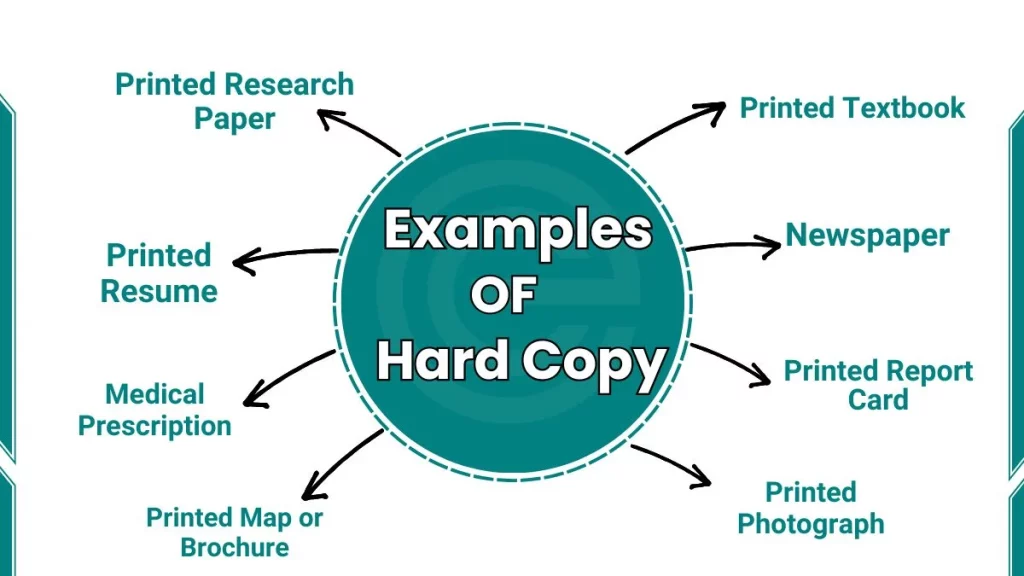
Examples of Hard Copy
Here are some hard copy examples in daily life:
1. Printed Textbook
A printed textbook is one of the most common hard-copy examples in academic settings. Students carry textbooks in their bags every day. Teachers assign chapters. Libraries store them on shelves. The content is fixed on paper. It does not change, does not need a password, and does not require internet access.
I notice that students retain more information when they read from a printed textbook compared to a PDF on screen. They underline sentences. They write notes in the margins.
2. Newspaper
A newspaper is a printed hard copy that delivers news, opinion, sports, and business information on large paper sheets.
Even in 2026, physical newspapers remain in circulation. Millions of readers worldwide pick up a morning newspaper. Libraries archive printed editions for historical research. Courts and legal systems accept newspaper clippings as documented evidence.
3. Printed Report Card or Academic Transcript
This example is directly relevant to every student reading this article. A printed report card is an official academic document issued by a school. It shows your grades, attendance, and teacher remarks for a specific term. Schools print and sign these documents. Parents sign them. They go into your permanent academic file.
An academic transcript works the same way. When you apply for college or a job, institutions often ask for an official printed transcript sent directly from your school.
4. Bank Statement or Invoice
A bank statement is a printed financial document issued by a bank or financial institution. Banks mail monthly printed statements to account holders. These statements list every transaction, deposit, withdrawal, and fee for a given period. Businesses also issue printed invoices to clients, listing services rendered and payment amounts due.
5. Printed Photograph
A printed photograph is a hard copy output produced from a digital or film image. When you print a photo at a photo lab or on a home inkjet printer, the digital file becomes a physical object. That physical print is the hard copy. It exists independently of the device that created it.
I keep a printed photo of my first graduating class on my desk. No digital version gives the same experience. The texture, the physical presence, that is what hard copy offers.
6. Printed Resume or CV
A printed resume is a physical document that presents your education, skills, and work experience to a potential employer.
Even with online job applications available everywhere, printed resumes are still required in many formal settings:
- Corporate walk-in interviews
- Government job applications
- University admission offices
- Career fairs and recruitment drives
I tell every student in my class to carry a printed resume to any professional meeting. A printed resume shows preparation. It can be handed directly to a hiring manager.
7. Printed Research Paper or Assignment
A printed research paper is one of the most common hard copy examples in school and university settings. Students write research papers, print them, and submit them physically. Teachers collect them, annotate them with a red pen, and return them with a grade. This process is standard in most schools worldwide.
In my experience teaching computer science, printed assignments help students take their work more seriously. When a document is going to be physically submitted and graded, students tend to proofread more carefully.
8. Medical Prescription
A medical prescription is a printed or handwritten hard copy document issued by a licensed doctor.
When a doctor diagnoses a condition, they write or print a prescription. The patient takes that physical document to a pharmacy. The pharmacist reads it, dispenses the medication, and keeps a copy. The entire process depends on a physical document.
9. Product Manual or Instruction Booklet
A product manual is a printed hard copy document included in the packaging of a physical product.
When you buy a smartphone, a laptop, a microwave, or a router, a printed instruction booklet comes inside the box. This booklet tells you how to set up the product, use its features safely, and troubleshoot common problems.
10. Printed Map or Brochure
A printed map is a physical hard-copy document that shows geographic locations, roads, routes, and landmarks. Tourist offices distribute printed maps to visitors. Government agencies publish printed city maps. Businesses print product brochures and distribute them at trade fairs. These are all hard copy documents.
GPS and Google Maps work well when you have mobile data. A printed map works everywhere — no signal required, no battery needed. This is why printed maps remain relevant even in 2026.