
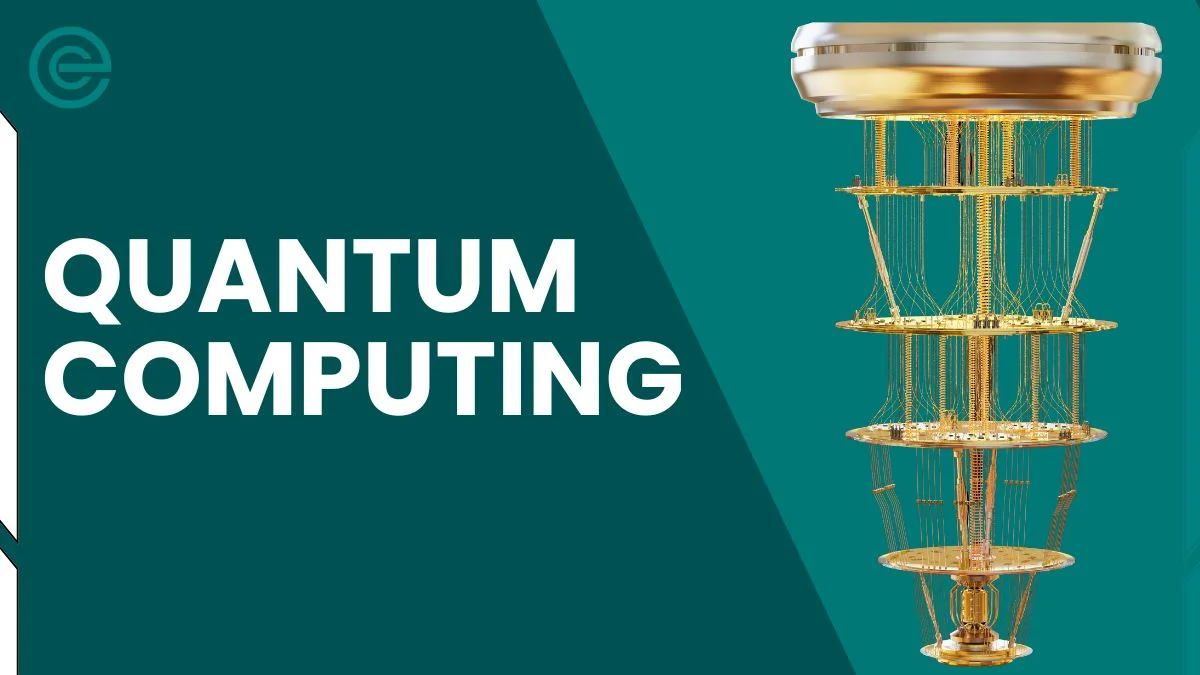
TL;DR: Quantum computing uses the principles of quantum physics (superposition and entanglement) to process complex data using qubits instead of traditional bits. It built for advanced molecular drug discovery, complex system optimization, post-quantum cryptography, and AI simulation.
Quantum Computing Definition
Quantum computing is a type of computing that uses quantum physics to process information. It uses qubits instead of normal bits. A qubit can be 0, 1, or a mix of both until it is measured. This helps quantum computers solve some hard problems faster than normal computers.
Key takeaways:
- Quantum computing uses qubits, not bits.
- It works with superposition, entanglement, and interference.
- It is not a replacement for your laptop. It is built for special problems.
What Is Quantum Computing?
Quantum computing means using the rules of quantum physics to process data. Normal computers use bits. Quantum computers use qubits.
The word “quantum” comes from quantum physics. This science studies very small things like electrons and photons. These particles behave in strange ways. Scientists use these rules to build a new kind of computer.
A quantum computer is great for problems with many variables. It is not made for emails, games, or social media.
What Does “Quantum” Mean in Quantum Computing?
In quantum computing, “quantum” means the behavior of tiny particles at the smallest scale. The word refers to quantum mechanics, the branch of physics that explains how atoms and light behave.
At this scale, particles can be in more than one state. They can also link with each other. Quantum computers use these two behaviors to do calculations.
What Is a Quantum Computer?
A quantum computer is a machine that performs quantum computing. It uses qubits and quantum rules to solve problems. Today’s quantum computers are big, cold, and costly. Most people use them through the cloud.
How Is Classical Computing Different From Quantum Computing?
Classical computers use bits that are always 0 or 1. Quantum computers use qubits that can be 0, 1, or a mix of both. Let’s recall how a normal computer works first.
A bit is the smallest unit of data. It is like a tiny switch, either off (0) or on (1). Every photo, video, and game is made from billions of bits. A normal computer works step by step. This is fast, but very complex problems can take too long.
| Feature | Classical Computing | Quantum Computing |
|---|---|---|
| Basic unit | Bit (0 or 1) | Qubit (0, 1, or both) |
| How it works | Binary logic, step by step | Superposition, entanglement, interference |
| Best for | Daily tasks, apps, websites | Special hard problems |
| Answers | Usually one exact answer | Often a probability |
| Temperature | Room temperature | Often near absolute zero |
| Availability | Everywhere | Mostly cloud access |
What Are the Main Principles of Quantum Computing?
Quantum computing is built on four main principles: superposition, entanglement, interference, and decoherence.
- Superposition: A qubit can be in a mix of states. Think of a coin spinning in the air. It is not just heads or tails while it spins. When you measure the qubit, it becomes a clear 0 or 1.
- Entanglement: Qubits can be linked. If you measure one, you learn something about the other. This works even if they are far apart. It does not send messages faster than light.
- Interference: This is the engine of quantum computing. Quantum algorithms boost the right answers and cancel the wrong ones. This is how the final answer appears.
- Decoherence: This happens when a qubit loses its quantum state. Heat, noise, or vibration can cause it. Engineers work hard to reduce it.
What Are the Types of Quantum Computing?
The main types of quantum computing are superconducting qubits, trapped ions, photonic systems, neutral atoms, and quantum dots. Scientists are testing all of them. No one type has won yet.
1. Superconducting Qubits
These use special circuits cooled close to absolute zero. At this point, electricity flows with no resistance. The circuits act like artificial atoms. They are very fast. Google and IBM use this method. But noise can easily disturb them.
2. Trapped Ions
Charged atoms are held in a vacuum by electric and magnetic fields. Lasers control them. They stay stable for a long time and give very accurate results. IonQ and Quantinuum work on this method. They are usually slower than superconducting qubits.
3. Photonic Systems
This uses particles of light called photons as qubits. The information is stored in the properties of the photons, like their direction or polarization. Optical devices such as mirrors and beam splitters guide them to perform calculations. The big challenge is building large and reliable systems.
4. Neutral Atoms
These are like trapped ions, but the atoms have no charge. Focused lasers called optical tweezers hold them in place. It is easier to arrange many atoms in a large grid. This method is promising because it is easier to arrange many neutral atoms in a large array. This makes it more scalable for future quantum computers.
5. Quantum Dots (Spin Qubits)
Quantum dots are tiny semiconductor pieces that trap a single electron. They fit well with current chip-making. This helps with future scaling.
Gate-based vs quantum annealing: Most machines are gate-based and can run many algorithms. Quantum annealers, like those from D-Wave, focus on optimization problems.
How Quantum Computers Work?
Quantum computers work by placing qubits in superposition, linking them, and using interference to find the right answer. Then they measure the result.
Think of a secret code. A normal computer tries one guess, then another. A quantum computer works differently. It does not simply try all guesses at once. It uses interference to make wrong answers weaker and the right answer stronger.
Here are the simple steps:
- Qubits start in a known state.
- Quantum gates put them in superposition.
- Gates entangle the qubits.
- Interference boosts the right answers.
- The computer measures the qubits and gives a result.
Quantum answers are often probabilistic. So the program runs many times to get a reliable result.
Quantum Hardware
Quantum hardware is the physical part of a quantum computer. It has a quantum processor (QPU), control electronics, and often a cooling system.
The QPU holds the qubits. Control systems send signals, like microwaves or lasers, to change qubit states. Many machines use dilution refrigerators that are colder than outer space. Some main types are:
- Superconducting qubits: Used by companies like Google and IBM.
- Trapped ions: Atoms controlled by lasers.
- Photonic systems: Use light particles to carry information.
Quantum hardware needs special conditions. Most quantum computers work at extremely low temperatures, near absolute zero. They also need protection from noise and errors. This makes them expensive and complex to build. Most machines are not portable. People use them through cloud platforms.
What are Quantum Algorithms?
Quantum algorithms are step-by-step instructions made for quantum computers. They use superposition, entanglement, and interference to solve problems.
Famous examples:
- Shor’s algorithm (1994): Factors big numbers very fast. It could break some current encryption.
- Grover’s algorithm: Searches unsorted data faster than classical methods. The speed-up is quadratic, not magic.
- Quantum simulation algorithms: Help model molecules and materials. This is where many experts expect early value.
Developers write quantum programs with tools like Qiskit (IBM), Cirq (Google), and PennyLane. These tools use Python.
What is Quantum Networking?
Quantum networking connects quantum devices using entanglement and photons. It aims to share quantum information in a secure way.
A key idea here is that quantum states cannot be copied perfectly. This is called the no-cloning theorem. It helps with secure methods like quantum key distribution.
Scientists also test quantum teleportation. It does not move matter. It transfers the state of a qubit using entanglement and a normal communication channel.
In the future, a quantum internet may connect quantum computers across the world.
What are Applications of Quantum Computing?
Quantum computing may help in medicine, chemistry, AI, cybersecurity, climate research, and optimization. Many of these uses are still in research or pilot stages.
- Medicine: Simulate molecules to help design new drugs.
- Chemistry and materials: Find better batteries and catalysts.
- Artificial intelligence: It can improve machine learning and data analysis.
- Cybersecurity: It can break old encryption methods but also create stronger ones.
- Climate research: It can simulate complex systems to understand global warming.
- Optimization: From traffic control to financial markets, quantum computers can find the best solutions quickly. According to McKinsey’s technology reports, this technology could grow into a major industry over the coming decade.
McKinsey-based estimates cited by IBM say quantum computing could become a USD 1.3 trillion industry by 2035. Treat this as a forecast.
For more details, read Applications of Quantum Computing.
What Are the Challenges of Quantum Computing?
The main challenges are high cost, high error rates, cooling needs, and scaling. The technology is not ready for home or school use.
- Cost: Quantum hardware is very expensive.
- Errors: Qubits are unstable. Decoherence causes mistakes.
- Cooling: Many machines need very low temperatures.
- Scaling: Useful problems need many reliable logical qubits.
- Software and skills: There are few experts and few proven algorithms.
- Early stage: Most tasks are still done better by classical computers.
Technology is still in the early stage, not ready for home or school use. Furthermore, as outlined in the NIST Post-Quantum Cryptography standards, organizations are already actively migrating to new cryptographic methods to defend against future quantum threats.
Also Read: