
Quick Answer: A programmer is a professional who writes, tests, and maintains code to build software, websites, mobile apps, and video games.
A programmer is a person who writes, tests, and fixes code. Code is a set of instructions that tells a computer what to do. Every app on your phone, every website, and every video game starts with a programmer.
In this guide, you learn who a programmer is, what they do every day, which skills they need, and how to become one.
Who Is a Computer Programmer?
A programmer is a person who writes instructions for computers. These instructions are called code or a program. A computer cannot think on its own. It only follows the steps a programmer gives it.
You can also call a programmer a coder, a computer programmer or a software developer. Programmers write code in programming languages like Python, Java and C++.
Who Was the First Programmer?
Ada Lovelace is often called the first computer programmer. She was a British mathematician. In the 1840s, she wrote notes with an algorithm for Charles Babbage’s planned Analytical Engine. Computers as we know them did not exist yet.
Other important names include:
- The ENIAC programming team, including Betty Jennings and Fran Bilas. They programmed one of the first electronic computers in the 1940s.
- Linus Torvalds, who created the Linux kernel. He is a famous example of a programmer whose software is used by many people.
What Are the Types of Programmers?
Here are different types of programmers:
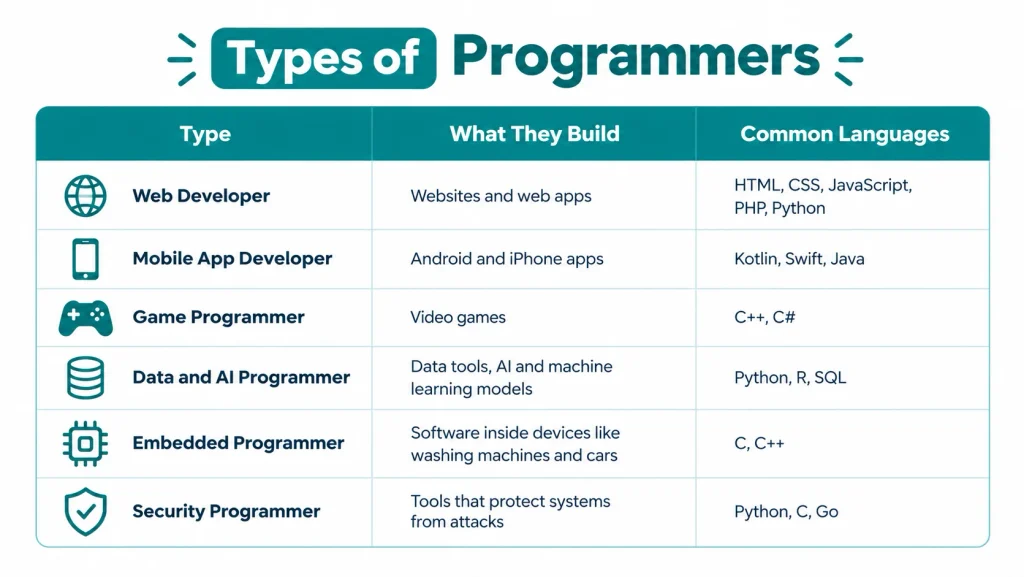
| Type | What they build | Common languages |
|---|---|---|
| Web developer | Websites and web apps | HTML, CSS, JavaScript, PHP, Python |
| Mobile app developer | Android and iPhone apps | Kotlin, Swift, Java |
| Game programmer | Video games | C++, C# |
| Data and AI programmer | Data tools, AI and machine learning models | Python, R, SQL |
| Embedded programmer | Software inside devices like washing machines and cars | C, C++ |
| Security programmer | Tools that protect systems from attacks | Python, C, Go |
1. Web Developers
Web developers build and design websites and web applications that run in web browsers like Chrome, Safari, or Edge. When you open an online store, read a blog, or use an online tool, a web developer built it. Their job is to ensure pages load quickly, look clean, and work smoothly on both desktop computers and mobile screens.
Front-End, Back-End and Full-Stack
Web developers have three common paths:
- Front-end developers build what you see on a website, like buttons and menus.
- Back-end developers build what you do not see, like the server and database.
- Full-stack developers do both.
2. Mobile App Developer
Mobile app developers create applications specifically for smartphones and tablets. If you use apps like WhatsApp, Instagram, or mobile games on your phone, you are using the work of a mobile app developer. Because Android and iOS (iPhone) operate differently, developers use specific languages like Kotlin or Swift to build apps tailored for each platform.
3. Game Programmer
Game programmers write the code that brings video games to life. They build physics engines, character movements, enemy AI, and user interfaces. They rely on fast, powerful programming languages like C++ and C# to keep games running smoothly without lag, even with complex 3D graphics.
4. Data and AI Programmer
Data and AI programmers handle large datasets and build artificial intelligence systems. They create tools that help companies analyze trends, make predictions, and build smart machine learning models. Because Python is flexible and powerful for handling data, it is the most popular language used in this field.
5. Embedded Programmer
Embedded programmers write software that lives inside physical hardware devices rather than traditional computers. This includes the internal code running inside smart home appliances, digital watches, microwave ovens, and modern car engines. Their code acts as a bridge, telling the physical hardware how to respond to user buttons and sensors.
Programming doesn’t exist in a vacuum; it is a core pillar of the broader world of Information Technology (IT). If you want to understand how software, networks, and hardware connect on a larger scale, you can read our detailed guide on What is Information Technology.
What Is the Difference Between a Programmer, Coder, Developer and Software Engineer?
These words mean similar things, and companies use them in different ways. The titles do not follow one standard rule. Here is a simple comparison.
| Title | What they mainly do | Simple meaning |
|---|---|---|
| Programmer / Coder | Write and fix code | Focus on writing the instructions |
| Software Developer | Design, build and test whole apps | Build complete software |
| Software Engineer | Plan the full system and follow engineering methods | Think about structure and quality |
| Web Developer | Build websites | Focus on the web |
In small companies, one person often does all of these jobs. In large companies, the roles are more separate. For a student, the main point is the same: all of them write code to solve problems.
Which Programming Languages Do Programmers Use?
Programmers use many languages. You do not need to learn all of them. In the 2025 Stack Overflow Developer Survey, JavaScript is still the most-used language at 66%, and Python follows at 57.9%. The same survey also lists HTML/CSS and SQL among the most used technologies. HTML/CSS is not a programming language. It is a markup and styling language for web pages.
Here is a simple guide:
- Python: Easy to read. Good for beginners, data and AI.
- JavaScript: Runs in every web browser. Good for websites.
- Java: Used for Android apps and large business systems.
- C and C++: Fast and powerful. Good for games and system software. Many schools use them to teach basic concepts.
- SQL: Used to work with databases.
My advice: Pick one language and stick with it for a few months. Switching languages every week slows you down.
What Skills Does a Programmer Need?
A good programmer needs technical skills and personal skills.
Technical Skills
- Logic and problem solving: Break a big problem into small steps.
- Algorithms: Know the step-by-step methods used to solve problems.
- Data structures: Know how to store data in lists, stacks, queues and trees.
- Databases: Know how to save and read data.
- Version control: Know how to use Git.
- Debugging: Know how to find and fix errors.
Personal Skills
- Patience: Bugs take time to find.
- Communication: You must explain your work to teammates and users.
- Teamwork: Most programmers work in groups.
- Willingness to learn: Tools and languages change fast.
Maths helps, but you do not need to be a maths genius. For most programming jobs, basic maths and clear logic are enough. Data science and game graphics need more maths.
What I See in the Classroom as a Computer Science Teacher
Teaching students every day gives me a clear view of what trips beginners up and what helps them succeed. Here are three common patterns I notice:
- Students copy code without understanding it: Many students copy code from tutorials without understanding why it works. When I give them a tiny variation of the problem—like changing a loop condition from
less thantoless than or equal to—the program breaks because they didn’t grasp the underlying logic. - Beginners fear error messages: Beginners often panic when red error text pops up on their screen. I teach my students to treat errors as helpful clues rather than failures. An error message usually tells you the exact line number where the computer got confused.
- Small projects work better than long theory: Theory books can feel exhausting. The moment a student successfully builds their first working calculator or text-based game, their entire attitude shifts. Seeing code come alive sparks genuine curiosity.
My core advice to every beginner is simple: Write a little code every day, even if it is just for 20 minutes. Consistent daily practice beats cramming for hours once a week.
Common Myths About Programmers
- Myth 1: You must be a math genius to code.Reality: Clear logic and patience matter much more than advanced math for most everyday programming jobs.
- Myth 2: Programmers work completely alone all day.Reality: Coding is highly collaborative. Programmers spend a large portion of their day talking to teammates, reviewing code, and planning features together.
- Myth 3: AI will completely replace programmers.Reality: AI tools assist with writing boilerplate code, but they still make logic errors. Programmers are needed to define requirements, architect solutions, and verify that the software works safely.
Frequently Asked Questions
Is a programmer the same as a software engineer?
Not always. A programmer mainly writes code. A software engineer also plans the system and follows engineering methods. Many companies use both titles for the same job.
Do I need a degree to become a programmer?
No, but a degree helps in many jobs. You can also learn through courses, practice and projects. A portfolio shows your skill.
Which language is best for a beginner?
Python is a good first choice because its code is easy to read. JavaScript is a good choice if you want to build websites.