
Quick answer (TL;DR): Examples of mainframe computers are IBM z17, IBM z16, IBM z15, IBM LinuxONE, Unisys ClearPath Forward, Fujitsu GS21, Hitachi VOS3, NEC ACOS, HPE NonStop, and Bull GCOS.
- Newest model: IBM z17, released on June 18, 2025.
- First commercial mainframe: UNIVAC I, delivered in 1951.
- Main users: banks, airlines, insurers, and governments.
Mainframe computers are large, highly secure enterprise computing systems. They are built to process massive volumes of data, transactions, and workloads with absolute reliability. They support thousands of users and applications concurrently without performance degradation.
What Are Examples of Mainframe Computers?
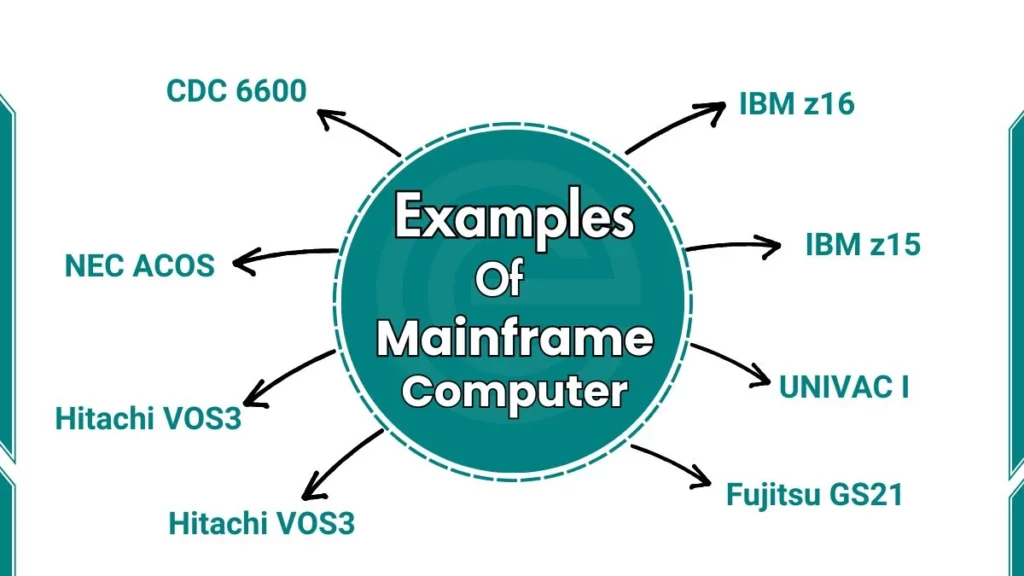
Common examples of mainframe computers include the IBM z17, IBM z16, and IBM z15. Other examples are Unisys ClearPath Forward, Fujitsu GS21, Hitachi VOS3, NEC ACOS, and HPE NonStop.
Here is a quick table of the 10 examples.
| # | Mainframe | Maker | Key fact |
|---|---|---|---|
| 1 | IBM z17 | IBM | Launched in 2025 with the Telum II AI chip |
| 2 | IBM z16 | IBM | Launched in 2022; first quantum-safe IBM mainframe |
| 3 | IBM z15 | IBM | Launched in 2019; built for hybrid cloud |
| 4 | IBM LinuxONE | IBM | Mainframe that runs Linux only |
| 5 | Unisys ClearPath Forward | Unisys | Runs MCP and OS 2200 software |
| 6 | Fujitsu GS21 | Fujitsu | Sales end in fiscal 2030 |
| 7 | Hitachi VOS3 | Hitachi | Used mainly in Japan |
| 8 | NEC ACOS | NEC | Used mainly in Japan |
| 9 | HPE NonStop | HPE | Fault-tolerant, mainframe-class system |
| 10 | Bull GCOS | Bull (Atos group) | Used in large European systems |
What are the top 10 examples of mainframe computers in 2026?
The top 10 examples of mainframe computers include cutting-edge current systems and influential historic models that shaped modern enterprise computing:
- IBM z17
- IBM z16
- IBM LinuxONE
- Unisys ClearPath Forward
- HPE NonStop
- Fujitsu GS21 Series
- IBM System/360
- UNIVAC I
- IBM z15
- Bull GCOS Systems
1. IBM z17
The IBM z17 is the latest flagship enterprise mainframe. It is designed to handle extreme transaction volumes and advanced AI workloads securely. It integrates high-performance on-chip acceleration to process real-time analytics and fraud detection natively.
Key highlights of the IBM z17 include:
- Powered by advanced processors like the Telum II chip architecture.
- Built with quantum-safe cryptography standards to protect sensitive financial data.
- Delivers near-zero downtime for mission-critical banking operations.
- Learn more about enterprise capabilities on the official IBM Z Systems Documentation page.
2. IBM z16
The IBM z16 introduced revolutionary on-chip AI acceleration to the mainframe market. It allows enterprises to run fraud detection models on every single transaction in real time. It remains widely deployed across major global financial institutions.
Core features of the IBM z16 include:
- Capable of processing billions of AI inferences per day directly on hardware.
- Industry-leading data privacy and cyber-resilience features.
- Seamless integration with hybrid cloud environments.
3. IBM LinuxONE
IBM LinuxONE is a specialized enterprise server family built entirely around Linux and open-source software, running on mainframe hardware infrastructure. It is heavily utilized by organizations looking for enterprise-grade security combined with open-source flexibility.
Why organizations use IBM LinuxONE:
- Runs popular Linux distributions like Red Hat Enterprise Linux and SUSE.
- Delivers massive consolidation ratios, replacing dozens of standard rack servers.
- Reduces data center energy consumption and physical footprint significantly.
4. Unisys ClearPath Forward
Unisys ClearPath Forward is a comprehensive enterprise mainframe environment that bridges legacy architecture with modern digital services. It is trusted heavily by governments, airlines, and large financial networks worldwide.
Key advantages of Unisys ClearPath Forward:
- Offers a secure, hybrid software and hardware operating model.
- Protects long-term legacy software investments while enabling modern API connectivity.
- Provides continuous system availability for critical public services.
5. HPE NonStop
HPE NonStop is an enterprise fault-tolerant server and mainframe-class system. It is built specifically for applications that cannot afford a single second of unscheduled downtime. It is widely used in stock exchanges and global payment networks.
Key strengths of HPE NonStop include:
- Architecture designed for 99.99999% uptime (fault tolerance at both hardware and software levels).
- Linear scalability for massive financial transaction processing.
- Real-time data replication across geographically distant data centers.
6. Fujitsu GS21 Series
The Fujitsu GS21 series represents traditional high-capacity enterprise mainframes. It is designed for large-scale commercial data processing. Fujitsu has announced strategic transition plans regarding its mainframe roadmap toward modern cloud solutions by the end of the decade.
Key aspects of the Fujitsu GS21 series include:
- Supports heavy corporate data management and legacy COBOL applications.
- Delivers robust batch processing performance for large retail and manufacturing firms.
- Explore broader enterprise infrastructure details on the Fujitsu Global Servers portal.
7. IBM System/360
The IBM System/360 was launched in 1964. It is the most historically significant mainframe architecture ever built. It unified small and large commercial computers into a single compatible family for the first time in computing history.
Why the System/360 matters:
- Introduced the concept of software compatibility across different machine sizes.
- Set the foundational blueprint for modern enterprise computing architecture.
- Transformed how businesses handle commercial data processing.
8. UNIVAC I
The UNIVAC I (Universal Automatic Computer) was the first commercial mainframe computer. It was manufactured in the United States and delivered to the U.S. Census Bureau in 1951. It marked the birth of the computer industry outside of academic and military labs.
Key facts about the UNIVAC I:
- Used magnetic tape for high-speed input and output data storage.
- Successfully predicted the 1952 U.S. presidential election results on live television.
- Pioneered the use of computers for business and statistical data processing.
9. IBM z15
The IBM z15 is a trusted enterprise server known for introducing Data Privacy Passports. They give organizations unprecedented control over data encryption even after it leaves the mainframe environment.
Core highlights of the IBM z15 include:
- Pioneered enterprise-wide data encryption controls at rest and in flight.
- Enabled cloud-native application deployment on secure mainframe infrastructure.
- Maintained high reliability for global supply chains and banking networks.
10. Bull GCOS Systems
Bull GCOS (Global Comprehensive Operating System) mainframes were originally developed by Bull (now part of Atos). It has served European banking, defense, and public administration sectors for decades.
Key characteristics of Bull GCOS:
- Optimized for secure, large-scale transaction and government database management.
- Provides robust multi-user processing and strict data sovereignty compliance.
- Serves as a core backbone for critical regional infrastructure in Europe.
What are the primary real-world uses of mainframes today?
Mainframes power the invisible digital infrastructure that keeps global commerce running smoothly every single day:
- Banking and Finance: Processing ATM withdrawals, credit card authorizations, and interbank money transfers instantly.
- Airlines and Travel: Managing global seat reservations and ticketing systems through platforms like Sabre.
- Government and Healthcare: Securing national census data, tax records, and electronic health insurance networks.
- For deeper reading on enterprise applications, check out our related guide on Uses of Mainframe Computers.
How Is a Mainframe Different From a Supercomputer?
A mainframe handles many small tasks at once. A supercomputer solves one huge math problem at top speed. Mainframes focus on uptime and security. Supercomputers focus on raw calculation speed.
| Feature | Mainframe | Supercomputer |
|---|---|---|
| Main job | Transactions and business data | Science and simulations |
| Users | Thousands at once | Few research teams |
| Priority | Uptime and security | Calculation speed |
| Examples | IBM z17, Unisys ClearPath | Frontier, Fugaku |
| Typical users | Banks, airlines, governments | Labs, weather centers |
Frequently Asked Questions (FAQ)
Are mainframe computers still used in 2026?
Yes, mainframes are actively used by over 70% of Fortune 500 companies, major banks, and government agencies because no other architecture matches their security and transaction throughput.
What is the newest IBM mainframe model?
The IBM z17 is the latest-generation enterprise mainframe. It features advanced built-in AI acceleration and quantum-safe cryptographic security.
Is a laptop or desktop a mainframe?
No. A laptop or desktop serves one user. A mainframe serves thousands of users at once.