
TL;DR
A truth table lists every possible True/False input for a logical expression and shows the output for each case. The table needs 2^n rows, where n is the number of different variables, so 2 variables give 4 rows and 3 variables give 8 rows. You build it in small steps: list the variables, fill the input columns, add one helper column for each part of the expression, and then read the final column.
What Is a Truth Table and Why Is It Important?
A truth table lists all possible True/False values of the inputs and the result of a logical expression for each case. Each row is one situation. The last column shows the final answer.
Truth tables are part of Boolean algebra and propositional logic. George Boole introduced Boolean algebra in the 1800s. Ludwig Wittgenstein and Emil Post both used the truth table method around 1921.
Truth tables matter because they:
- Remove guesswork from logic problems.
- Show if an expression is always true, always false, or mixed.
- Prove that two expressions are equal.
- Help you find bugs in
ifconditions. - Help you design logic gates and digital circuits.
Most students make their first mistake in the implication row. They see F → T and think the answer is False. I ask them to think of a promise: “If it rains, I will take an umbrella.” If it does not rain, I did not break my promise, so the result is True. After this example, the mistake drops a lot.
A simple real-life example: A door alarm rings only if the system is ON and the door is OPEN. That is an AND rule. If either input is false, the alarm stays silent.
What Are the Basic Logical Operators?
Every truth table uses a small set of operators. T means True and F means False.
NOT (¬P) flips the value.
| P | ¬P |
|---|---|
| T | F |
| F | T |
- AND (P ∧ Q) is true only when both inputs are true.
- OR (P ∨ Q) is true when at least one input is true.
- XOR (P ⊕ Q) is true when the inputs are different.
| P | Q | P ∧ Q | P ∨ Q | P ⊕ Q |
|---|---|---|---|---|
| T | T | T | T | F |
| T | F | F | T | T |
| F | T | F | T | T |
| F | F | F | F | F |
Implication (P → Q) is false only when P is true and Q is false. Biconditional (P ↔ Q) is true when P and Q have the same value.
| P | Q | P → Q | P ↔ Q |
|---|---|---|---|
| T | T | T | T |
| T | F | F | F |
| F | T | T | F |
| F | F | T | T |
What Are the Truth Tables for Universal Gates (NAND and NOR)?
NAND is “NOT AND”. NOR is “NOT OR”. Both are called universal gates because you can build any other gate from only NAND gates or only NOR gates.
| P | Q | P NAND Q | P NOR Q |
|---|---|---|---|
| T | T | F | F |
| T | F | T | F |
| F | T | T | F |
| F | F | T | T |
- NAND is false only when both inputs are true.
- NOR is true only when both inputs are false.
- Chip makers use these gates often because one gate type can build a whole circuit.
How Many Rows Does a Truth Table Need? (The 2^n Formula)
A truth table needs 2^n rows, where n is the number of different input variables. Each variable has two values: True or False. So every new variable doubles the row count.
| Variables (n) | Rows (2^n) |
|---|---|
| 1 | 2 |
| 2 | 4 |
| 3 | 8 |
| 4 | 16 |
| 5 | 32 |
| 10 | 1,024 |
Count only the different variables. The expression (P ∧ Q) ∨ P has two variables, so it has 4 rows.
How Do You Fill the Input Columns Without Missing a Row?
Use this pattern. It works for any number of variables.
- The first variable column: first half T, second half F.
- Each next column: cut the block size in half.
- The last variable column: T, F, T, F on every row.
For 3 variables (8 rows), P has blocks of 4, Q has blocks of 2, and R has blocks of 1.
Tip from my students’ work: Students who skip this pattern and fill rows by guessing often miss one row. Counting the rows against 2^n takes five seconds and catches this error.
Why Does This Formula Matter for Big Problems?
Rows double with every new variable. With 20 variables, you need 1,048,576 rows. So computers use other tools for large problems, such as SAT solvers. In class, you usually work with up to 4 variables.
How Do You Construct a Truth Table Step by Step?
Follow these five steps to construct a truth table every time:
- Write the expression.
- List all variables.
- Count the rows with 2^n.
- Fill the input columns.
- Add one helper column for each part, then add the final column.
Tip: Want to verify your results automatically? You can use our interactive Truth Table Calculator Tool to generate complete tables and check your manual calculations step by step.
How Do You Define Variables and Initial Inputs?
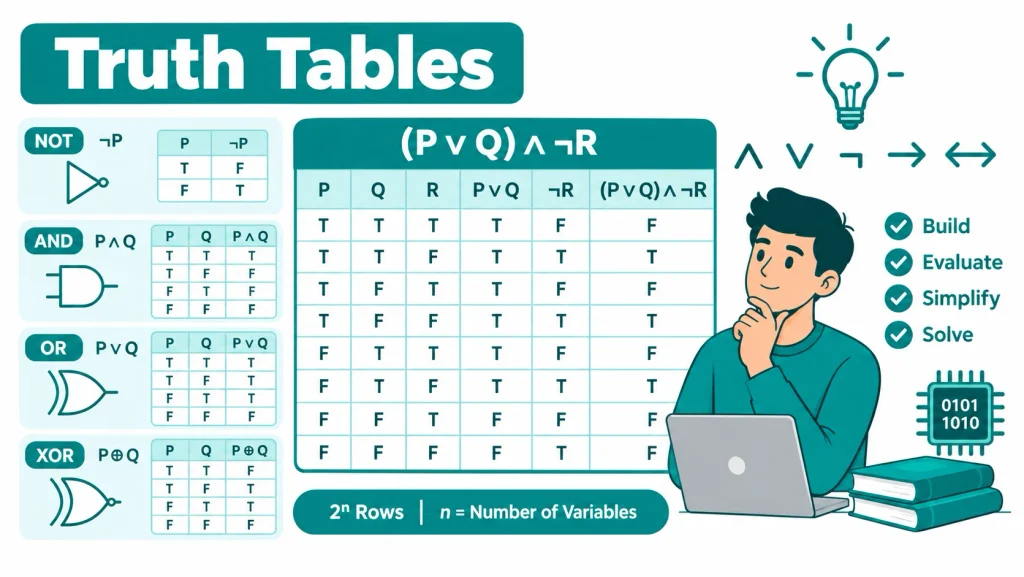
Take this expression: (P ∨ Q) ∧ ¬R
The variables are P, Q, and R. So n = 3, and you need 2^3 = 8 rows.
| P | Q | R |
|---|---|---|
| T | T | T |
| T | T | F |
| T | F | T |
| T | F | F |
| F | T | T |
| F | T | F |
| F | F | T |
| F | F | F |
Check that no two rows are the same. This catches mistakes early.
How Do You Evaluate Complex Logical Operators Step by Step?
Break the expression into small parts. Use one helper column for each part. The order of operations is:
- Brackets
- NOT
- AND
- OR
- Implication and biconditional
For (P ∨ Q) ∧ ¬R, add the helper columns P ∨ Q and ¬R. Then join them with AND.
| P | Q | R | P ∨ Q | ¬R | (P ∨ Q) ∧ ¬R |
|---|---|---|---|---|---|
| T | T | T | T | F | F |
| T | T | F | T | T | T |
| T | F | T | T | F | F |
| T | F | F | T | T | T |
| F | T | T | T | F | F |
| F | T | F | T | T | T |
| F | F | T | F | F | F |
| F | F | F | F | T | F |
The expression is true in 3 of 8 cases.
Another example: a login rule. Take the code if age >= 18 and has_id:. Let P mean “age is 18 or more” and Q mean “has ID”. The expression is P ∧ Q.
| P (age ≥ 18) | Q (has ID) | P ∧ Q (allowed) |
|---|---|---|
| T | T | T |
| T | F | F |
| F | T | F |
| F | F | F |
Only one row gives access. This is how you check that a condition does what you want.
How Do You Tell If an Expression Is a Tautology, Contradiction, or Contingency?
Look only at the final column.
- Tautology: all True. Example:
P ∨ ¬P. - Contradiction: all False. Example:
P ∧ ¬P. - Contingency: a mix of True and False. The table above is one.
How Do You Prove Two Expressions Are Equal?
Build a table for both expressions. If the final columns match in every row, the expressions are logically equivalent. Here is De Morgan’s law:
| P | Q | ¬(P ∧ Q) | ¬P ∨ ¬Q |
|---|---|---|---|
| T | T | F | F |
| T | F | T | T |
| F | T | T | T |
| F | F | T | T |
Both columns match, so ¬(P ∧ Q) equals ¬P ∨ ¬Q.
What Are Common Mistakes to Avoid?
- Skipping rows. Check the count against 2^n.
- Ignoring brackets. Solve the inside first.
- Mixing up OR and XOR. When both inputs are true, OR gives True, and XOR gives False.
- Wrong implication row. Only T → F is false.
- Skipping helper columns. Doing everything in one step causes errors.
Where Are Truth Tables Used in Programming and Circuit Design?
Truth tables check conditions in code and design logic gates in hardware. Every program and every processor depends on this logic.
How Do Truth Tables Help in Programming?
Every if and while condition is a logical expression. A truth table lets you test it before you run it.
- Simplify conditions. Use De Morgan’s law to make code shorter. For example,
not (a and b)equals(not a) or (not b). - Find bugs. Test every input case, not just the ones you expect.
- Understand short-circuiting. In many languages,
A && BskipsBwhenAis false. - Write test cases. Each row can be one unit test.
- Use bitwise operators.
&,|,^, and~follow the same tables, bit by bit.
Python can print a truth table for you:
from itertools import product

print("P     Q     P and Q   P or Q")
for p, q in product([True, False], repeat=2):
print(p, q, p and q, p or q)The product function creates every True/False combination.
How Are Truth Tables Used in Digital Circuit Design?
Each logic gate matches one truth table: AND, OR, NOT, NAND, NOR, XOR, and XNOR. Engineers follow this flow:
- Write the truth table.
- Turn it into a Boolean expression.
- Simplify it (often with a K-map).
- Build the circuit with gates.
Example: the half adder. It adds two single bits, A and B.
| A | B | Sum | Carry |
|---|---|---|---|
| 0 | 0 | 0 | 0 |
| 0 | 1 | 1 | 0 |
| 1 | 0 | 1 | 0 |
| 1 | 1 | 0 | 1 |
Sum matches XOR. Carry matches AND. So a half adder needs one XOR gate and one AND gate. Full adders combine half adders, and adders sit inside the arithmetic logic unit (ALU) of a CPU.
How Do You Convert a Truth Table into a Simplified Circuit Using K-Maps?
A Karnaugh map (K-map) is a grid version of a truth table. It helps you simplify a Boolean expression by grouping the 1s.
Take a truth table where the output is 1 for these inputs: (A=0, B=1), (A=1, B=0), and (A=1, B=1).
| B = 0 | B = 1 | |
|---|---|---|
| A = 0 | 0 | 1 |
| A = 1 | 1 | 1 |
Follow these steps:
- Put each output from the truth table into its cell.
- Circle groups of 1s. Group sizes must be 1, 2, 4, 8, and so on.
- Make each group as large as possible.
- Write one term for each group.
Here, the bottom row (A = 1) is one group, and the right column (B = 1) is another. The result is A + B. That is a single OR gate.
For 3 or 4 variables, label the grid in Gray code order (00, 01, 11, 10). Groups can also wrap around the edges of the map.
Where Else Are Truth Tables Used?
- Databases: SQL uses three-valued logic (True, False, Unknown for NULL).
- Artificial intelligence: rule-based systems use propositional logic.
- Search filters: AND, OR, and NOT queries follow the same rules.
- Exams: truth tables are a standard topic in discrete mathematics.
To see how these truth tables fit into larger computational models, check out our guide on Logic in Computer Science.
Practice Problems: Test Your Truth Table Knowledge (With Solutions)
Try each problem on paper first. Then read the answer.
Problem 1: Build the truth table for ¬P ∨ Q.
Answer: For (P, Q) = TT, TF, FT, FF, the results are T, F, T, T. This matches P → Q. So the two expressions are equivalent.
Problem 2: Is P ∧ (P ∨ Q) a tautology?
Answer: No. The results are T, T, F, F, which is the same as P. It is a contingency.
Problem 3: Is ((P → Q) ∧ P) → Q a tautology?
Answer: Yes. The final column is T, T, T, T. This rule is called modus ponens.
Problem 4: How many rows does a table with 5 variables need?
Answer: 2^5 = 32 rows.
Frequently Asked Questions
What Is the Difference Between a Truth Table and a Logic Gate?
A truth table is a paper method that shows the output for all inputs. A logic gate is a physical or digital part that does the same job. Every gate has a truth table.
Can a Truth Table Have More Than Two Values?
Standard truth tables use True and False (or 1 and 0). Some systems use three values, such as SQL with NULL. This is called multi-valued logic.