
Quick Answer (TL;DR):
Logic in computer science is a formal system that encodes facts so machines can reason, infer new information, and make decisions. Propositional logic handles simple true/false statements. Predicate logic handles complex relationships using variables and quantifiers. In 2026, logic still powers databases, expert systems, Prolog-based reasoning, and safety guardrails inside modern AI.
Logic is the backbone of every computer system you use today. Without logic, a computer cannot make a single decision. In my CS classes, I always tell students one thing first: a computer does not “think.” It just follows logic rules very fast. That is the real secret behind AI, search engines, and even simple calculators.
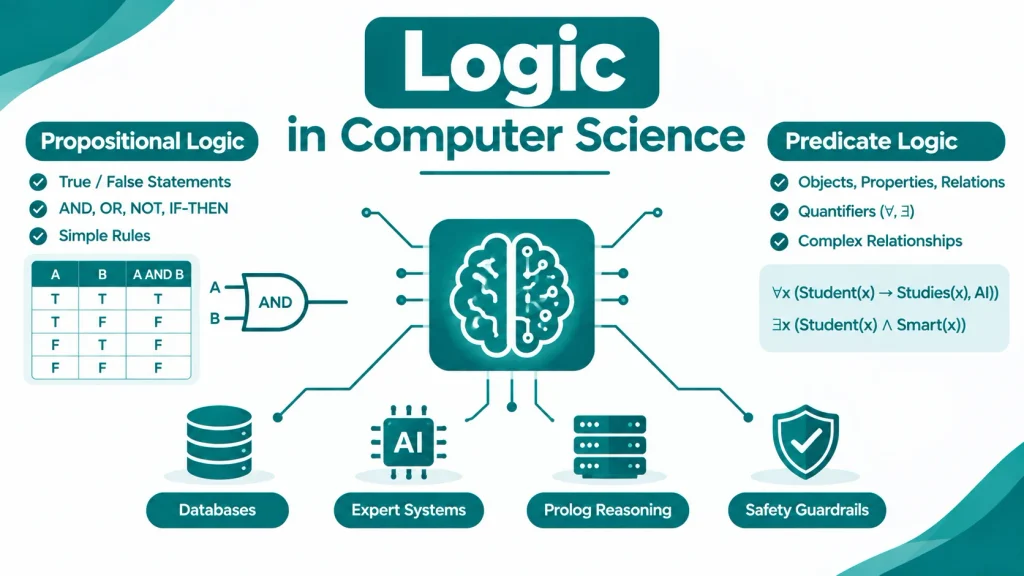
What is Logic in Computer Science?
Logic in computer science is a formal system of rules. These rules help a computer decide if a statement is true or false. Computers cannot understand feelings or guesses. They only understand clear yes/no answers.
This is why every programming language is built on logic. When you write an if-else statement, you are using logic directly.
Logic in computer science comes from mathematical logic. Early computer scientists like George Boole and Alan Turing built the base of this field. Boole created Boolean logic, which uses only two values:
- True (1)
- False (0)
Every modern computer, from your phone to a supercomputer, runs on this simple idea. Logic gates inside a CPU (AND, OR, NOT gates) are physical versions of Boolean logic. So logic is not just a coding concept. It is also the basis of computer hardware.
What Types of Logic Are Used in Computer Science?
Computer science mainly uses two types of logic for knowledge representation. Students often mix these up, so I explain them with easy examples.
1. Propositional Logic (Simple True or False Statements)
Propositional logic deals with simple statements. Each statement is either true or false, and nothing else. It cannot describe details inside the statement.
Example:
- “Ali is a student.” → This is either true or false.
- “It is raining today.” → True or false.
Propositional logic uses connectives like AND, OR, NOT, and IF-THEN to join statements. It works well for small, simple problems. But it has a big limit: it cannot talk about groups, objects, or relationships.
2. Predicate Logic (First-Order Logic) for Complex Relationships
Predicate logic is also known as first-order logic (FOL), is more powerful. It is more powerful. It adds variables, objects, and quantifiers. This lets it describe relationships, not just single facts.
Predicate logic uses two main quantifiers:
- ∀ (for all) — used for statements about every object in a group
- ∃ (there exists) — used for statements about at least one object
Example:
- “All students study AI.” → ∀x (Student(x) → Studies(x, AI))
- “There exists a student who is smart.” → ∃x (Student(x) ∧ Smart(x))
Propositional logic struggles with groups of objects because it needs a separate statement for every single object in that group. Predicate logic solves this problem by using one general rule for all objects. This is why AI systems, databases, and expert systems prefer predicate logic over propositional logic.
Here is a quick side-by-side Comparison of Propositional Logic and Predicate Logic:
| Feature | Propositional Logic | Predicate Logic (FOL) |
|---|---|---|
| Scope | Simple true/false statements | Objects, properties, and relations |
| Expressiveness | Low (cannot represent groups) | High (uses ∀ and ∃ quantifiers) |
| Variables | Not used | Used |
| Best used for | Basic Boolean circuits, simple rules | Knowledge graphs, AI reasoning, ontologies |
| Example | “It is raining.” | “All humans are mortal.” |
What Are the Core Components of a Logic-Based System?
Every logic-based system has two main parts. They work together to store facts and produce new answers.
- Knowledge Base (KB): This is the storage part. It holds all the known facts, rules, and axioms about a topic. Think of it as a library of true statements.
- Inference Engine: This is the thinking part. It reads the rules in the knowledge base and applies logic to create new facts or reach a conclusion.
Before adding rules to a Knowledge Base, developers first break down real-world problems into clear, logical steps. If you want to understand how programmers structure complex problems before writing rules, check out our guide on problem decomposition and algorithm building.
How Do Computers Store and Process Structured Information?
A computer does not store facts like a human brain does. It stores facts as structured data, using clear formats that logic rules can process.
Here is how this works step by step:
- The system breaks real-world facts into small units, like objects, properties, and relations.
- Each unit becomes a symbol or a variable (for example,
Student(Ali)). - Logic rules connect these symbols to show relationships (for example,
Teaches(Teacher, Student)). - An inference engine reads these rules and creates new facts from old ones.
This method is called symbolic knowledge representation. Databases use this idea daily. A relational database, for example, stores data in tables. Each row is basically a logical fact, and SQL queries use logical operators (AND, OR, NOT) to filter that data. So when you run a database query, you are using applied logic, whether you notice it or not.
How Do Deduction, Induction, and Abduction Differ in Logical Reasoning?
Logic systems reason in three main ways. Each one moves from facts to conclusions in a different manner.
- Deductive reasoning: This starts from a general rule and reaches a guaranteed true conclusion. Example: “All humans are mortal. Ali is a human. So Ali is mortal.” If the rules are true, the result is always true.
- Inductive reasoning: This builds a general rule from repeated observations. Example: “Every crow I have seen is black, so all crows are black.” The result is likely true, but not guaranteed.
- Abductive reasoning: This finds the most probable explanation for an observed fact. Example: “The ground is wet, so it probably rained.” This is common in diagnosis systems and troubleshooting tools.
AI systems often mix all three. Deduction gives certainty, induction helps machine learning models find patterns, and abduction helps systems guess the best explanation when full information is missing.
What Is the Difference Between Forward Chaining and Backward Chaining?
Inference engines use two main strategies to move through rules. Both are common in expert systems.
- Forward chaining: The system starts with known facts and moves forward to find a conclusion. It keeps applying rules until it reaches a new fact or a goal. This method works well when you have lots of data and want to see what it leads to.
- Backward chaining: The system starts with a goal and works backward to check if the known facts support it. This method works well when you already have a specific question and want to verify it.
A simple way to remember this: forward chaining asks, “What can I conclude from these facts?” Backward chaining asks, “Can I prove this goal using the facts I have?” Medical diagnosis tools often use backward chaining, since they start with a suspected disease and check it against symptoms.
How Is Logic Used in Artificial Intelligence and Expert Systems?
Artificial intelligence started with logic-based systems, long before deep learning became popular. Researcher Ron Brachman described first-order logic as the standard by which AI knowledge representation methods should be judged. This shows how central logic still is to AI theory, even in 2026.
Logic plays a big role in these AI areas:
- Expert systems – These use IF-THEN rules to copy the decisions of a human expert. Early medical diagnosis tools like MYCIN used this method, and modern rule-based fraud detection systems still follow the same logic pattern.
- Natural Language Processing (NLP) – Predicate logic helps convert human sentences into structured meaning that a machine can process.
- Automated reasoning – Logic engines check if a set of facts is consistent, and they find new facts from existing ones.
- Robotics – Robots use logic rules to plan safe movements and avoid obstacles.
- Large Language Models (LLMs) – Even today’s LLMs use logic-based guardrails and rule checks alongside their neural network core to keep answers structured and safe.
Modern AI mixes logic-based systems with machine learning. Pure logic systems are precise but rigid. Machine learning is flexible but sometimes unpredictable. Combining both is called neuro-symbolic AI.
What Are Fuzzy Logic and Non-Monotonic Logic?
Classic logic only allows two values: true or false. But real life is not always that simple. This is why computer science added newer logic types.
- Fuzzy logic: This allows partial truth, not just true or false. A value can be “70% true.” Fuzzy logic is used in devices like washing machines, air conditioners, and camera autofocus, where a fixed yes/no rule does not work well.
- Non-monotonic logic: In classic logic, once something is true, it stays true forever. Non-monotonic logic allows a conclusion to change when new facts arrive. Example: “Birds fly” is true, but when you learn “Tweety is a penguin,” the system takes back the earlier conclusion. This type of logic is closer to how humans update their beliefs.
Both of these logic types help AI systems handle the real world better, where facts are often incomplete or changing.
What Are the Limits of Logic in Knowledge Representation?
Logic is powerful, but it is not perfect. Students should know its limits too, because real-world systems rarely use logic alone.
- Logic struggles with uncertainty. It cannot easily express ideas like “probably true” or “most of the time.” Real-world facts are often uncertain, not fixed.
- Logic needs exact rules. If a rule is missing an exception (like the penguin example), the system gives a wrong answer.
- Large logic systems get slow. As rules grow, checking consistency becomes computationally expensive.
- Common-sense reasoning is hard. Humans use context and experience. A pure logic system needs every single rule written by hand.