
Did you know that an analog computer solves real-world problems by processing continuous signals instead of binary data? Many devices operate on analog principles, even though digital systems are more common today. To understand the base concept before exploring its uses, you can read a detailed guide on what is analog computer.
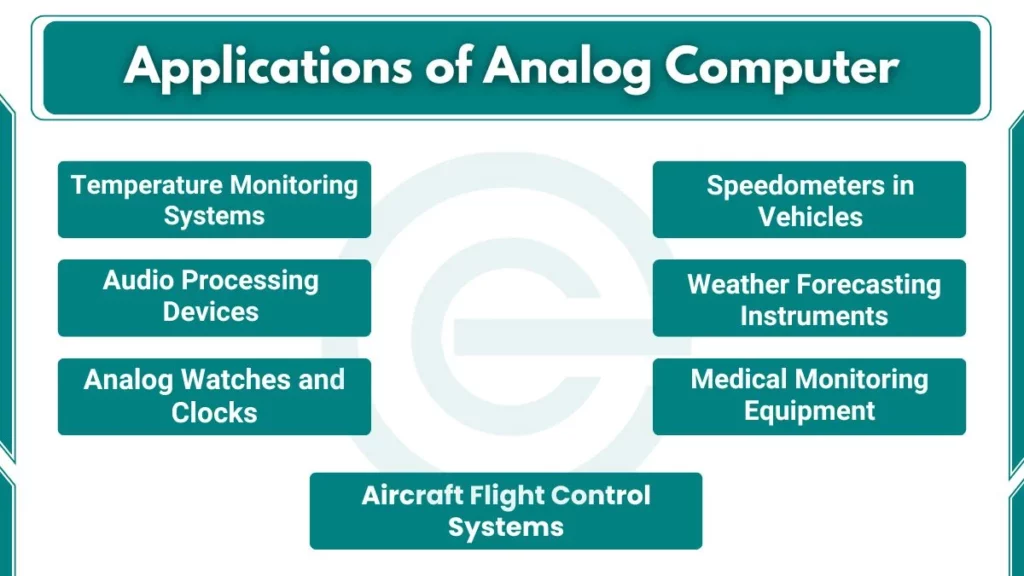
Applications of Analog Computer in Daily Life
The following are applications of analog computer:
1. Temperature Monitoring Systems
Temperature monitoring systems use analog circuits to measure and control heat variations. These systems detect changes in temperature and convert them into electrical signals. The analog circuit processes these signals and provides immediate control output. This ensures stable temperature in many household and industrial systems.
Examples:
- Thermostats
- Refrigerators
- Room heaters
2. Speedometers in Vehicles
Speedometers measure the speed of a vehicle using analog mechanisms. Wheel rotation generates a varying signal. The analog system converts this signal into a speed reading on a dial. This process works continuously and provides instant feedback to the driver.
Examples:
- Car speedometers
- Motorcycle speedometers
- Bus speed indicators
3. Audio Processing Devices
Audio processing uses analog circuits because sound signals are naturally continuous. These circuits amplify, filter, and modify audio signals without sampling. This maintains signal integrity and allows real-time sound reproduction.
Examples:
- Microphones
- Audio amplifiers
- Sound mixers
4. Weather Forecasting Instruments
Weather instruments rely on analog computation to measure environmental changes. These instruments convert physical conditions into readable values. The response is continuous and accurate, which supports meteorological analysis.
Examples:
- Barometer
- Hygrometer
- Anemometer
5. Analog Watches and Clocks
Analog clocks measure time using mechanical or oscillatory movement. The system converts periodic motion into angular movement of hands. This method provides a continuous representation of time without digital sampling.
Examples:
- Mechanical wall clocks
- Wrist analog watches
- Pendulum clocks
6. Medical Monitoring Equipment
Medical devices capture biological signals that change continuously. Analog circuits process these signals and display measurable health information. Real-time processing is essential for diagnosis and monitoring.
Examples:
- ECG machines
- EEG machines
- Blood pressure monitors
7. Aircraft Flight Control Systems
Aircraft require stable and fast control responses. Analog computers process sensor data such as altitude and air pressure without delay. The output helps maintain aircraft stability and supports autopilot functions.
Examples:
- Autopilot systems
- Stability control units
- Navigation instruments
8. Industrial Control Systems
Industrial processes depend on accurate and continuous control. Analog systems monitor temperature, pressure, fluid flow, and other physical parameters. The system adjusts operations to maintain safe and efficient production.
Examples:
- Chemical plant controllers
- Pressure control systems
- Motor speed regulators
9. Audio-Video Broadcasting
Broadcasting systems use analog waves to transmit data over long distances. Analog circuits modulate and demodulate these waves. This supports radio and television communication.
Examples:
- AM radio transmitters
- FM radio receivers
- Analog television broadcast systems
10. Robotics and Automation
Robots depend on sensor feedback to perform movement. Many sensors produce analog signals. Analog processing converts these signals into control commands. This allows smooth and precise robotic actions.
Examples:
- Distance sensors
- Light sensors
- Angle sensors
To understand the strengths and limitations of analog systems, you can also read a detailed guide on the advantages and disadvantages of analog computers.
FAQs
Why is analog processing important in audio devices?
Sound signals are analog. Analog circuits process these signals directly without conversion, which supports real-time audio output.
How do analog clocks represent an application of analog computing?
Analog clocks use mechanical movement to represent time. This movement is continuous and works as a physical computation process.
Why do industries use analog control systems?
Industrial processes involve temperature, pressure, and flow, which change continuously. Analog systems provide fast and stable control.
Why is analog processing important in audio devices?
Sound signals are analog. Analog circuits process these signals directly without conversion, which supports real-time audio output.