
MAN networks offer impressive benefits like fast data transfer and centralized management, yet they demand substantial investment and technical expertise. Understanding both sides of this networking solution helps students and professionals make informed technology decisions.
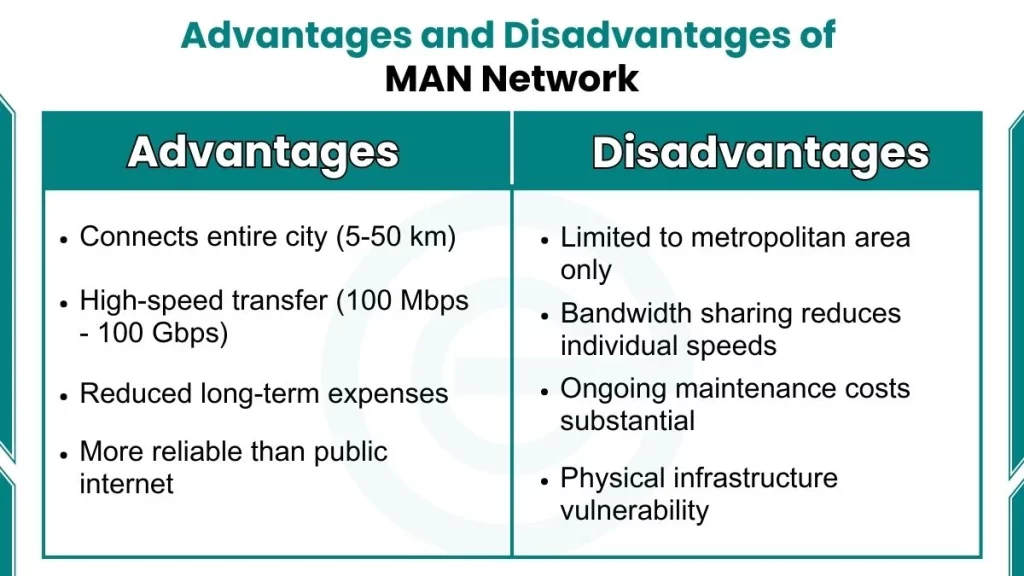
Advantages of MAN Network
Metropolitan Area Networks offer numerous benefits that make them valuable for city-wide connectivity needs. Here are the advantages of metropolitan area network:
1. Wide Area Coverage Within City Limits
MAN networks cover entire metropolitan areas effectively. A single network can span up to 50 kilometers. This coverage connects buildings and locations that traditional LANs cannot reach.
Consider a university with five campuses across a city. A MAN network keeps all campuses connected seamlessly. Students at one campus can access library resources from another campus without delays.
2. Bridges the Gap Between LAN and WAN
MAN networks occupy the middle ground between LANs and WANs. They provide more coverage than LANs while remaining more manageable than WANs.
Organizations with multiple city locations benefit from this positioning. They avoid the complexity and cost of WAN infrastructure. At the same time, they gain more connectivity than separate LANs provide. This balance makes MAN an ideal choice for metropolitan operations.
3. High-Speed Data Transfer
MAN networks can transmit data at speeds of 200 megabits per second or more. Modern MAN implementations using fiber optic cables achieve speeds from 100 Mbps to 100 Gbps. These speeds support bandwidth-intensive applications effectively.
The high bandwidth supports several activities:
- Video conferencing between different office locations
- Large file transfers across the network
- Cloud application access without lag
- Real-time collaboration on shared documents
- Streaming services for educational or business purposes
4. Reduced Long-Term Operational Costs
MAN networks offer cost savings beyond initial setup. Organizations benefit from centralized billing with a single service provider. Network maintenance becomes more streamlined and efficient. The shared infrastructure reduces per-location networking expenses significantly.
These savings accumulate over time. Organizations allocate saved resources to other business needs. The return on investment becomes apparent within the first few years of operation.
5. Centralized Resource Access
MAN networks enable efficient resource sharing across all connected locations. Organizations centralize their servers, databases, and storage systems. All branch offices access these centralized resources as if they were local.
The benefits include:
- Centralized data backup and disaster recovery
- Shared file servers accessible from any location
- Common application servers for all users
- Unified database systems across the organization
- Reduced hardware costs through resource consolidation
6. Improved Collaboration
Teams at different locations work together seamlessly through MAN networks. Employees share files instantly without internet upload and download delays. Real-time data synchronization keeps everyone updated. Video conferencing quality improves significantly compared to internet-based connections.
7. Better Security Implementation
Centralized security management protects the entire network more effectively. Organizations implement uniform security policies across all locations. Firewalls protect data at the network perimeter. Encryption safeguards data transmission between locations. Intrusion detection systems monitor all network traffic continuously.
8. Easy to Expand and Upgrade
Organizations expand their MAN networks without disrupting existing operations. Adding new locations to the network requires minimal changes. The modular architecture supports growth naturally. Bandwidth allocation adjusts based on changing organizational needs.
Disadvantages of MAN Network
Here are some disadvantages of a metropolitan area network:
1. Significant Investment Requirements
Organizations need substantial financial resources for MAN deployment. MAN networks have high installation and regular maintenance costs. The return on investment takes several years to materialize. Budget planning must account for both setup and ongoing operational expenses.
2. Complex and Time-Consuming Installation
MAN network deployment requires months of planning and execution. The process involves multiple stages and stakeholders. Setting up and managing a MAN requires experienced techs and network administrators to ensure the system works properly.
Installation stages include:
- Site surveys and feasibility studies
- Network design and architecture planning
- Municipal permits and regulatory approvals
- Physical infrastructure installation
- Equipment configuration and testing
3. Physical Infrastructure Challenges
Installing physical network infrastructure disrupts urban environments. MAN requires a lot of physical cabling to connect different locations. Construction crews dig trenches along city streets. Traffic patterns change during installation periods. Businesses near installation sites experience temporary inconveniences.
4. Limited Geographic Scope
MAN networks can only cover one city. Organizations with inter-city operations cannot rely solely on MAN. A company with offices in different cities needs WAN connections between metropolitan areas. MAN works only within its designated geographic boundary.
5. Bandwidth Sharing Issues
Multiple users share the same MAN infrastructure. Network congestion occurs during peak usage hours. Bandwidth issues can arise if the demand for data transmission exceeds the network’s capacity. Performance degrades when many users transfer large files simultaneously.
Organizations experience slowdowns during busy periods:
- Morning hours when employees log in simultaneously
- End-of-month reporting periods with heavy database queries
- Video conference sessions involving multiple locations
- Backup operations during business hours
- Software update deployments across the network