
An analog computer is a computing system that processes continuous data to perform mathematical operations. It represents information in the form of physical quantities such as voltage, rotation, or pressure. These computers were widely used in engineering, scientific simulations, and industrial control tasks before digital systems became the dominant technology.
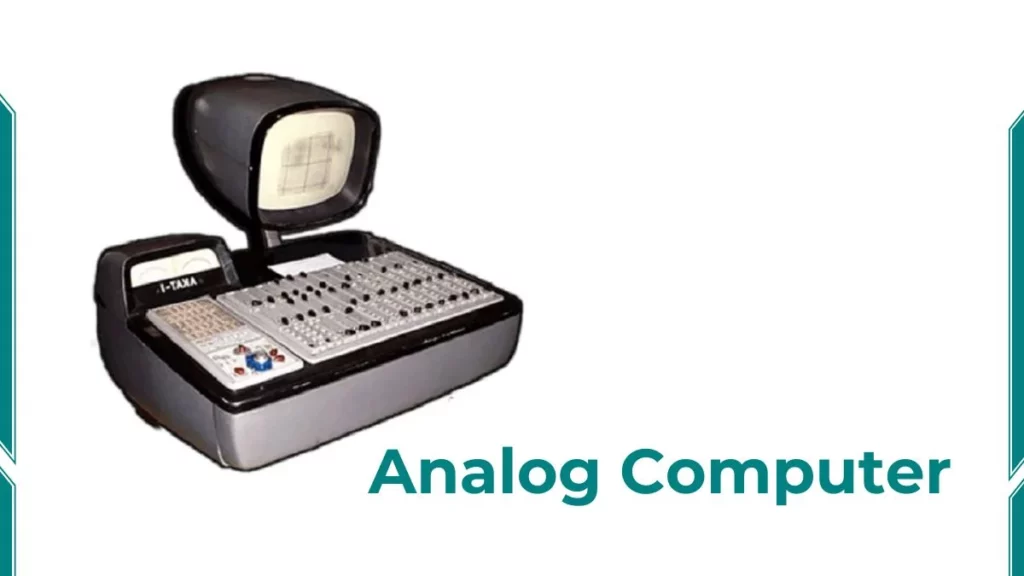
Analog Computer Definition
An analog computer is a computing device that processes continuous information. It represents variables using physical quantities instead of discrete numbers.
In technical terms, an analog computer performs calculations by mapping mathematical problems to physical systems. These systems can be electrical, mechanical, or hydraulic. Continuous signals represent the input and output values.
Characteristics of Analog Computers
- Continuous Data Handling: Analog computers handle continuous inputs. The values can take any point within a range.
- Real-Time Processing: They give results instantly because operations occur through physical changes.
- Direct Representation of Physical Quantities: Voltage, rotation, or fluid movement represent mathematical variables directly.
- Accuracy vs Precision: They support practical accuracy but limited precision. Small disturbances affect output.
- Non-Programmable or Limited Programming: These computers use fixed circuits. Reconfiguring them requires physical adjustment.
- Specialized Use Cases: They work well for simulations and engineering systems but not for general-purpose tasks.
Types of Analog Computers
Analog computers can be classified into different types based on their working principles and the technology used. Here are types of analog computers:
- Mechanical Analog Computers: Mechanical computers use gears, rods, levers, and rotating disks. They perform arithmetic operations and simulations through motion.
- Electrical Analog Computers: These systems use resistors, capacitors, inductors, and operational amplifiers. They convert input voltages into output voltages.
- Electronic Analog Computers: Electronic analog computers use vacuum tubes or transistors. They provide higher speed and more accurate results than mechanical systems.
- Hydraulic Analog Computers: Hydraulic systems use fluid pressure and flow. Fluid movement models mathematical equations, particularly in control systems.
- Hybrid Computers (Analog + Digital): Hybrid systems combine analog speed and digital precision. They perform complex calculations with real-time outputs.
Components of Analog Computer
Here are analog computer components:
- Input Devices: Input devices include sensors, transducers, potentiometers, and switches. They convert physical quantities into measurable signals for the system.
- Processor / Computing Elements: Operational amplifiers, integrators, differentiators, and multipliers form the main processing units. They perform arithmetic and mathematical functions.
- Output Devices: Meters, galvanometers, plotters, and oscilloscopes display results. Some devices show numerical readings, while others provide visual graphs.
- Function Generators: Function generators create signals such as sine waves, square waves, or ramp waves. These signals represent dynamic input variables.
- Connecting Wires & Patch Panels: Wires and patch panels connect various modules. They allow customization of the computational path.
- Power Supply Units: Stable power supply units provide voltage and current required for operations. Fluctuations can reduce accuracy.
How Analog Computers Work
1. Input Values Are Given
- You first feed continuous values like voltage, current, temperature, speed, etc.
- These values represent the real-world quantity you want to calculate.
2. Values Are Converted Into Electrical Signals
- The analog computer changes your input values into analog signals (usually voltages).
- Example: 5 volts may represent “5 units” in a math problem.
3. Signals Pass Through Components
The signals move through analog components like:
- Adders (for addition)
- Integrators (for solving calculus equations)
- Multipliers
- Function generators
Each component performs part of the mathematical operation.
4. Signals Get Modified During the Process
- As the signal flows, the components increase, decrease, combine, or transform the values.
- This is how equations are solved using changes in electrical signals.
5. The Final Signal Represents the Answer
- After processing, the output is again an analog signal (voltage or current).
- This output is the solution to your problem.
6. Output Is Displayed
So you can see the result instantly.
The final value is shown through:
- A meter
- A graph (oscilloscope)
- A plotter
If you want to understand this process in depth, read our comprehensive guide on working principle of an analog computer.
Analog vs Digital Computer
| Feature | Analog Computer | Digital Computer |
|---|---|---|
| Data Type | Continuous | Discrete |
| Accuracy | Moderate | High |
| Speed | Real-Time | Depends on CPU |
| Flexibility | Low | High |
| Use Cases | Simulation, control | General-purpose computing |
Advantages of Analog Computers
- Fast for Real-Time Calculations
- Easy to Model Physical Systems
- Continuous Representation
- Can Handle Complex Equations Naturally
- Low Power Use in Some Designs
Disadvantages of Analog Computers
- Lower Accuracy Due to Noise
- Difficult to Program or Reconfigure
- Bulky Hardware Requirements
- Limited Storage Capability
- Lack of General-Purpose Use
FAQs
Why are analog computers used?
They are used for real-time simulations, solving differential equations, and handling continuous data.
Are analog computers faster than digital?
For specific engineering simulations, analog computers can be faster due to parallel and continuous processing.
What fields rely on analog computing?
Aerospace, robotics, weather modeling, and physics research rely on analog computation.
Why did analog computers decline?
They declined due to limited accuracy, poor storage capability, and the rise of versatile digital computers.